CFDs are complex instruments and come with a high risk of losing money rapidly due to leverage. 76% of retail investor accounts lose money when trading CFDs with this provider. You should consider whether you understand how CFDs work and whether you can afford to take the high risk of losing your money.
CFDs are complex instruments and come with a high risk of losing money rapidly due to leverage. 76% of retail investor accounts lose money when trading CFDs with this provider. You should consider whether you understand how CFDs work and whether you can afford to take the high risk of losing your money.


Moving Average in Stock Market: How to Use SMA and EMA for Trading Strategies
A Moving Average (MA) is one of the most widely used technical indicators in the stock market, helping traders and investors identify price trends by smoothing short-term price fluctuations. By calculating the average price of a stock over a specific period, Moving Averages provide a clearer view of market direction, whether prices are moving upward, downward, or sideways.
In stock trading, Moving Averages are commonly used to identify trends, generate buy or sell signals, and support technical analysis. Understanding how Moving Averages work can help investors make more informed trading decisions and better evaluate market conditions.
What Is a Moving Average in the Stock Market?
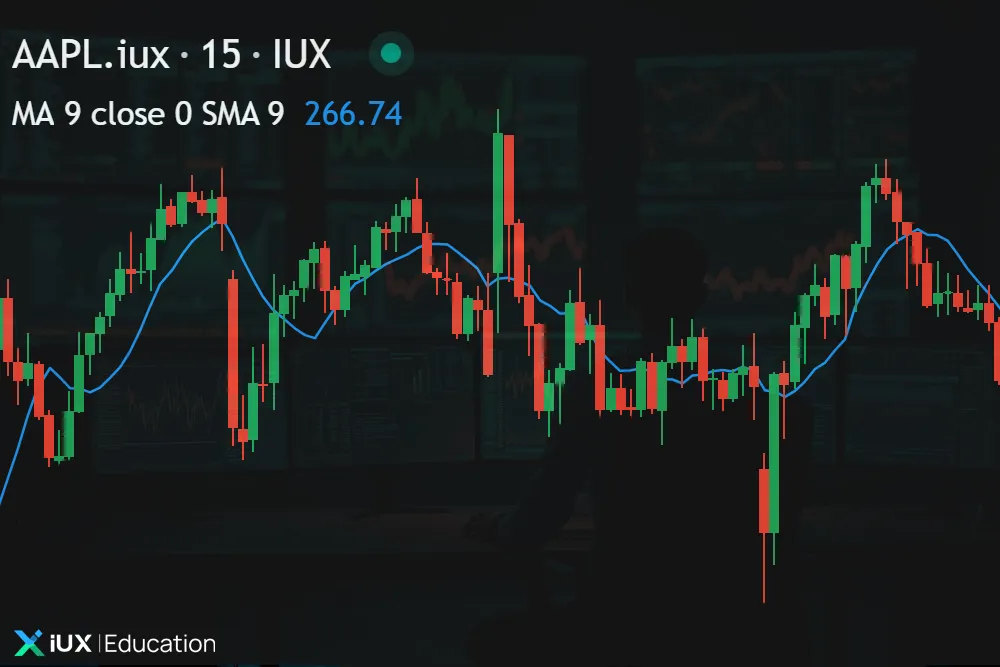
Moving Average (MA) is a technical indicator used in the stock market to help traders and investors identify the direction of a price trend. By calculating the average price of an asset over a specific period, a Moving Average reduces short-term market noise and provides a clearer view of the underlying trend.
There are several types of Moving Averages, with the Simple Moving Average (SMA) and Exponential Moving Average (EMA) being the most commonly used. While the SMA calculates the average price using equal weighting across all data points, the EMA places greater emphasis on recent prices, allowing it to react more quickly to market movements. The choice between SMA and EMA often depends on an investor’s trading style, time horizon, and market conditions.
In stock trading, Moving Averages are widely used to identify trend direction, confirm potential reversals, and generate trading signals through crossover strategies. They can also act as dynamic support and resistance levels, helping traders analyze market behavior and improve decision-making. Because of their simplicity and versatility, Moving Averages remain one of the most popular tools in technical analysis.
Types of Moving Averages
-
Simple Moving Average (SMA)
The Simple Moving Average (SMA) is calculated by averaging the closing prices of a stock over a specified period. For example, a 10-day SMA is calculated using the closing prices from the previous 10 trading days. Because each price receives equal weight, the SMA provides a smooth view of the overall market trend and is commonly used to identify long-term price direction.
-
Exponential Moving Average (EMA)
The Exponential Moving Average (EMA) gives greater weight to recent prices, allowing it to react more quickly to market changes than the SMA. Due to its responsiveness, the EMA is widely used in stock trading strategies to identify short-term trends and potential entry or exit opportunities.
.jpg.webp)
Exponential Moving Average
Using Moving Averages in Stock Trading
-
Trend Following with Moving Averages
Investors can use Moving Averages to identify the primary market trend. When the Moving Average line is above the closing price, it indicates an uptrend. Conversely, if it is below the closing price, it signals a downtrend.
-
Crossover Strategy
This strategy involves comparing short-term and long-term Moving Averages, such as using the 20-day EMA (Exponential Moving Average) with the 50-day EMA. When the 20-day EMA crosses above the 50-day EMA, it signals a buying opportunity. If it crosses downward, it signals a selling opportunity. This technique helps investors determine the right timing to buy or sell according to the changing trend.
-
Using Moving Averages as Support and Resistance
Some investors use Moving Averages as support and resistance levels, commonly utilizing the 50-day or 200-day SMA (Simple Moving Average) on long-term charts.

Advantages of Using Moving Average (MA) Techniques
_Techniques.webp.webp)
-
Helps Identify Market Trends
The moving average makes trends more visible by smoothing out price movements on a chart. This helps investors understand the direction of a price trend, allowing them to decide on entry or exit points in the market at optimal times.
-
Easy to Use and Time-Efficient
The moving average technique is straightforward and easy to understand, requiring no complex calculations. This makes it suitable for both beginner and experienced investors who need effective analysis without the complexity.
-
Acts as a Signal for Entry and Exit in Investments
Moving averages can be used as signals for making buy or sell decisions. For example, when a short-term moving average crosses above a long-term moving average, it’s considered a buy signal; conversely, the opposite crossing serves as a sell signal.
 |
Tip: Use two MAs together—one short-term and one long-term. When the short-term MA crosses above the long-term MA, momentum is strengthening. When it crosses below, momentum is weakening. This simple crossover check can instantly improve timing on entries and exits. |
Enhance your trading strategy with IUX.
Access real-time charts, fast indicators, and powerful tools to apply Moving Averages with precision.
Start trading smarter on IUX today.

Cautions When Using Moving Average Techniques
-
Moving Averages Cannot Predict the Future
Moving averages use past price data for calculation. Therefore, they cannot reliably predict future trends, but rather only indicate trends over the calculation period. Users should consider combining this technique with other analytical methods.
-
Delay in Buy-Sell Signal Indication
Moving averages, especially Simple Moving Average (SMA), tend to have a delay because they are based on past prices. Consequently, trend changes might appear slower than reality, which may cause buy or sell signals to lag behind the actual market situation.
-
Selecting an Appropriate Time Period for the Asset
Choosing the right time period for a moving average is crucial. A period that is too short may lead to overly frequent signals, while a period that is too long may cause delayed signals. The chosen period should match the asset's nature and the market trend.
Summary
Moving averages are an extremely useful tool in stock trading, helping investors track primary price trends and identify suitable entry and exit points. Choosing the right type of moving average depends on the investor's goals and trading style. Investors should experiment with different moving averages within time frames that suit their own strategies to enhance profit opportunities and minimize risks in the market.
💡FAQs
Q: Which type of Moving Average is better for beginners—SMA or EMA?
A: SMA is simpler and less sensitive to sudden price changes, making it easier for beginners to understand. EMA reacts faster to new data, which is useful for active traders but can create more noise for newcomers.
Q: What is the best time period to use for Moving Averages?
A: It depends on your trading style. Short-term traders often use 10–20 period MAs for quick signals, while long-term investors typically use 50–200 period MAs to identify major trends.
Q: Can Moving Averages be used alone to make buy or sell decisions?
A: Not recommended. Moving Averages provide trend insights but can lag behind real price movements. They are most effective when combined with other tools like RSI, MACD, or support–resistance levels.


Note:CFDs are complex instruments and come with a high risk of losing money rapidly due to leverage. 76% of retail investor accounts lose money when trading CFDs with this provider. You should consider whether you understand how CFDs work and whether you can afford to take the high risk of losing your money.
Source: what is moving average? , how a moving average works?